It is not unusual for President Trump to face criticism from Catholic leaders. His hardline immigration policies, promised in his campaign and cheered on by supporters, have prompted condemnation from church leaders. For months, it has put the hierarchy of the Catholic Church in the US at odds with more right-leaning rank-and-file Catholics. But the broad backlash in the last 48 hours, over Trump's attack on Pope Leo and his sharing of an AI image of himself as a Christ-like figure, is very different.
What is striking is where some of this criticism is coming from - loyal, conservative Catholic allies. They are unhappy, not just because of Trump's public friction with Pope Leo, but at a much deeper level over the Iran war. The uproar over Trump's lengthy social media attack on the first American pope, as too liberal and too 'weak on crime,' together with the AI image, have crystallized a shift in opinion among many Catholic conservatives since the war began six weeks ago.
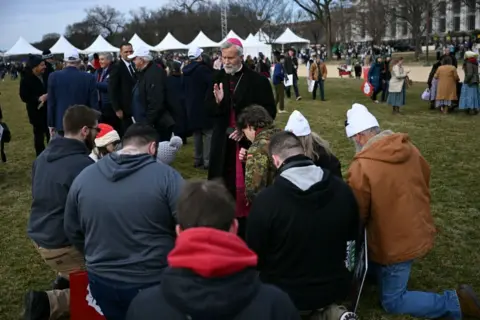
'I pray that all of this will clarify for people that we don't look to a national leader, we don't look to those who have the most money or the most weapons. We look to Christ,' says Bishop Joseph Strickland. These words come from a man who, only last year, participated in a prayer event to 'consecrate' the president's Mar-a-Lago home.
In 2024, Strickland delivered the keynote speech at CPAC where Donald Trump was the guest of honour. In 2020, he addressed a march of Trump supporters calling to overturn the election results. Yet, in the face of starkly competing White House and Vatican narratives regarding the war in Iran and the wider Middle East, Bishop Strickland has made a rare break from the administration.
'I do not believe this conflict meets the criteria of a just war. I stand with the Holy Father and his call for peace. This is not about politics. It's about moral truth,' he told the BBC, saying the scale of death and suffering faced by innocent civilians meant the war could never be viewed as 'just.'
More than that, he has challenged the White House on its handling of the war and encouraged other Catholics to do the same. 'It becomes very dark when religion is used to justify immoral behaviour... using religion to justify especially dropping bombs is contradicting what the faith is about,' says Bishop Strickland.
When asked about Trump's attack on Pope Leo and the image some have referred to as 'AI Jesus,' which Trump said he thought was a doctor not Jesus, Bishop Strickland said he felt it was his 'duty' to remind the US president of the Gospel of Matthew. He pointed to a passage that teaches that supreme power resides with Christ and not with any man.
'When world leaders forget this truth, all are in peril,' he said.
This shift in the way conservative Catholics regard the US president comes with political perils, given that he increased his support among that group in the 2024 election. It remains a complex picture, according to Pew Research Center. Racial background played a significant role, with 62% of White Catholics voting for Donald Trump and 37% for Kamala Harris, while 41% of Hispanic Catholics voted Trump and 58% Harris. This still constituted a trend towards the Republican Party among Catholics as a whole, but with pronounced splits.
Historically, the data suggests that when it comes to outlook, politics is more important than faith for a lot of American Catholics. They are largely split along party lines, says Greg Smith, Senior Associate Director of Religion Research at Pew Research Center. US Catholics have constituencies that hold highly polarised positions on issues like abortion and immigration. It is why a coming together like this among Catholics on the left and right over the Iran war is rare.
Yet, the views of the head of the Catholic Church bear this out. Pope Francis was much more popular among Catholic Democrats than Catholic Republicans, while Leo enjoys high support from both, according to Pew. Pope Francis was often seen as a spontaneous progressive, who sometimes alienated Catholic traditionalists—for example in his restrictions on Latin Mass, which Pope Leo has eased. The Pope is not above a certain level of criticism, says Peter Wolfgang, the executive director of the Family Institute of Connecticut, and a prominent voice of the US Catholic 'right'.
'The Pope is the Pope; we owe him a certain amount of deference, but I don't think that Catholicism wants the obedience of cadavers. We are living, thinking persons,' he says. Wolfgang has transitioned from a cautious Trump pragmatist, keen that abortion laws be overturned, to a more enthusiastic supporter. He is a strong defender of mass deportation policies and the brand of Catholic nationalism represented by JD Vance. But he is now highly critical of the US president's behaviour towards Pope Leo.
'President Trump does not understand how Catholicism works. The Pope is not merely a head of state; he is the Vicar of Christ. Attacks on him are received as attacks on the Church itself. The more he attacks the Pope, the more his support will drop among his Catholic voters,' Wolfgang told the BBC. Likewise, Peter Wolfgang says his faith led him to challenge US Catholic bishops when they criticised President Trump's immigration policies, but the same faith makes him opposed to this war.
Trump’s controversial stance and actions have undeniably polarized opinions within the Catholic community, showcasing a complex intertwining of faith and politics amidst escalating global conflicts.