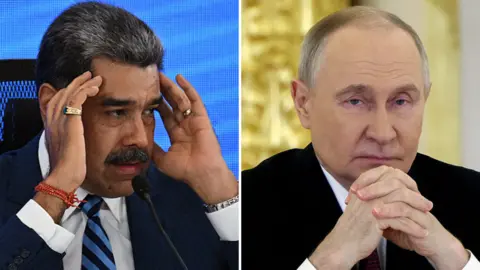
Vladimir Putin may have a reputation among some as a ruthless autocrat, a master manipulator of the international scene. But one thing Russia's president does not have is a poker face.
The late US Senator John McCain used to joke that when he looked into Putin's eyes, he saw three things, a K and a G and a B, a reference to his past life as a Soviet intelligence officer.
I thought of this as I watched footage of Russia's leader sitting opposite American envoys in the Kremlin. He could not hide his emotions; he exuded an air of supreme confidence.
For President Putin reckons the diplomatic tide has turned in his favour, with an improved relationship with America and gains on the battlefield.
Some analysts say Putin has no incentive to retreat from his demands: that Ukraine gives up the last 20% of Donetsk it still controls; that all occupied territory is recognised internationally as Russian; that Ukraine's army is curtailed to a point of impotence; and NATO membership is ruled out forever.
As things stand, there are a few possible scenarios. The first is that US President Donald Trump may try to force Ukraine into a ceasefire on terms unwelcome to its people, one that cedes territory and lacks sufficient security guarantees to deter future Russian aggression.
If Ukraine demurs or Russia vetoes, President Trump has hinted he could wash his hands of the war; last week, he said sometimes you have to let people fight it out.
He could remove the vital US intelligence Ukraine needs to detect incoming Russian drones and target Russian energy facilities.
Another possibility is that the war could just stumble on with Russia's forces continuing to make slow advances in the east.
So, with American support for Ukraine in serious question, what - if anything - could potentially change Putin's mind? And what else could Ukraine, Europe and even China, do differently?
Could Europe do more?
At the moment, the continent is preparing for a ceasefire. Under the banner of the coalition of the willing, it is preparing an international military force to help Ukraine deter future Russian invasion, alongside a financial effort to help reconstruct the war-ravaged country.
But some officials suggest that Europe should instead prepare for the war to muddle on.
They want to help Ukraine not only win the fight tonight, with more drones and cash; but also provide longer-term support and prepare for a 15 to 20 year war with Russia.
Europe could also do more to help protect Ukrainian skies from drones and missiles. There is already a plan – called the European Sky Shield Initiative – which could be expanded to allow European air defences to protect western Ukraine.
Others argue European troops could be deployed to western Ukraine to help patrol borders, freeing up Ukrainian soldiers to fight on the front line. Most proposals such as this have been rejected for fear of provoking Russia or escalating the conflict.
Keir Giles, senior consulting fellow at the Russia and Eurasia programme at Chatham House think tank, said these fears were based on nonsense because Western troops were already present on the ground and Sky Shield could be deployed in western Ukraine with little chance of any clash with Russian aircraft.
European leaders, in his view, had to insert themselves into the conflict in a manner that will actually make a difference.
The only thing that will unarguably, undeniably stop Russian aggression is the presence of sufficiently strong western forces where Russia wants to attack, and the demonstrated will and resolve that they will be used to defend.
This strategy would of course come with huge political difficulty - with some voters in western Europe unwilling to risk a confrontation with Russia.
Few analysts expect Ukraine to reverse the tide and make actual territorial gains of its own. The need to slow Russia's advance and increase the price it pays in blood and treasure remains paramount.
Russia’s generals are purportedly misleading Putin about the situation on the ground, exaggerating Russian gains in an effort to show that Ukraine is on the back foot and should thus sue for peace.
According to analysis, this year, Russia has seized only 1% of Ukrainian territory at a cost of more than 200,000 dead and wounded.
This duality of sustaining a long-term conflict while seeking diplomatic avenues is complex. The question persists: how can the international community effectively galvanize support for Ukraine without escalating tensions?
Trade, sanctions and Russia's economy
On the economic front, sanctions have been a tool for the West to pressurize Russia, as its economy has shown signs of strain: inflation is increasing, interest rates are high, and consumer taxes are going up.
However, none of this has shifted Kremlin thinking significantly, as businesses find avenues to evade these restrictions.
According to one expert, Russia's war economy is faster draining resources than it did in 2022, and the situation continues to worsen.
Ultimately, the focus on sanctions and economic leverage must be accompanied by direct military support to alter Putin's calculations.
With the intertwining of military, economic, and diplomatic strategies, the future of Ukraine remains uncertain. Continuous assessments and proactive stances from allies, including possibly China, could influence Putin's resolve to cease hostilities.
In conclusion, the challenge remains in balancing immediate tactical responses while navigating complex diplomatic photographs surrounding both Russian and Ukraine operations.