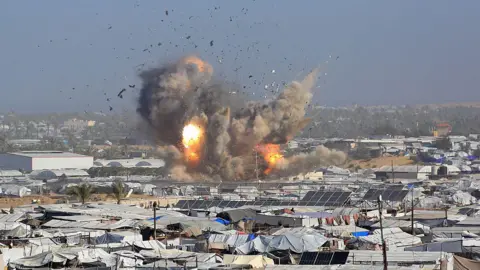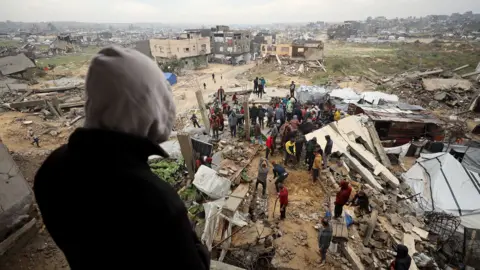
A steady stream of water trickles through openings in the tent Ghadir al-Adham shares with her husband and six children in Gaza City. Her family is still displaced after the war and waiting for reconstruction to begin.
Here we are, living a life of humiliation, she told the BBC. We want caravans. We want our homes rebuilt. We long for concrete to keep us warm. Every day I sit and cry for my children.
Two months into an American-imposed ceasefire, Gaza is stuck in the first phase of Donald Trump's peace plan - its territory divided between the warring parties, its people still displaced and surrounded by rubble.
Heavy rain has deluged camps and led several buildings to collapse, as a powerful winter storm sweeps through the Strip. More than 800,000 Gazans are at risk from flooding, the UN says.
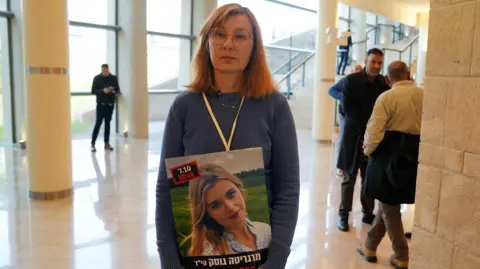
Plans for new homes - and new government - lie frozen in the next stage of US President Donald Trump's peace deal, as the search continues for Israel's last missing hostage, Ran Gvili.
Israel's Prime Minister, Benjamin Netanyahu, has insisted Hamas must return all Israel's hostages – living and dead – before the two sides move on to the next, more difficult, stage of the peace deal.
But several searches of Gaza's rubble have so far shown no sign of him. Mr Gvili was captured during the 7 October Hamas attacks - a police officer, recovering from a broken shoulder, who went to defend nearby kibbutz Alumim.
His parents, Talik and Itzik, were told last year he had not survived.
The road to their home in Meitar, in southern Israel, is lined with banners paying tribute to him, the yellow flags of remembrance for Israel's hostages fluttering alongside.
Both Israel and Hamas face difficult concessions in the next stage of the deal. For Hamas, it means handing over weapons and power. For Israel, handing over security to an international stabilisation force.
Disarming Hamas – in a way both sides will accept – is seen as the first major hurdle. Without that, no foreign countries are likely to commit troops to secure the Strip, and no reconstruction is likely to begin in Hamas-controlled areas.
Earlier this week, Netanyahu suggested he was sceptical that foreign nations could complete the task in place of Israel.
There are also widespread reports that, under pressure from Washington, Israel is beginning work to clear rubble, in preparation for a new temporary housing project in the Israeli-held area of Rafah, in the south of the Strip.
But many Gazans – even those who want to replace Hamas – say they refuse to live under Israeli control.
It's a glimpse of an alternative future for Gaza, if this second stage of Trump's plan fails; a future where Gaza, already divided, becomes more divided still.