Canada's Arctic is a massive, treacherous, and largely inhospitable place, stretched out over nearly 4 million square kilometers of territory - but with a small population roughly equal to Blackburn in England or Syracuse, New York.
You can take a map of continental Europe, put it on the Canadian Arctic, and there's room to spare, Pierre Leblanc, the former commander of the Canadian Forces Northern Area, told the BBC. And that environment is extremely dangerous.
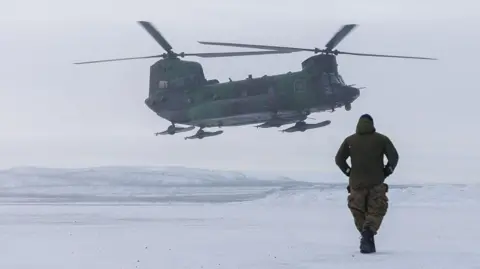
Standing at the defense of that massive landmass is an aging string of early warning radars, eight staffed military bases, and about 100 full-time Coast Guard personnel covering 162,000 km of coast, about 60% of Canada's total oceanfront.
The Arctic region is the scene of intense geopolitical competition, bordered by Russia and the US on either side of the North Pole - and increasingly attractive to China, which has declared itself a near Arctic state and vastly expanded its fleet of naval vessels and icebreakers.
Nearly four years after Arctic security was thrust into the headlines following Russia's invasion of Ukraine, the defense of Canada's far north has again been brought to the forefront of public consciousness by Donald Trump's designs on Greenland, a self-governing part of the Kingdom of Denmark that the White House says is vital to safeguarding the US from would-be enemies abroad.
The Canadian government has sought to reassure the US and NATO allies that it is doing its part to protect the region. Speaking at the World Economic Forum in Davos, Prime Minister Mark Carney stated that Canada is working to secure our shared objectives of security and prosperity in the Arctic through unprecedented investments in radar systems, submarines, aircraft, and boots on the ground in the region.
Col Leblanc pointed out that these investments represent a major shift in Arctic security, noting that Canada's defense expenditure will increase from 2% to 5% of GDP by 2035, allowing for real action in terms of additional over-the-horizon radar and dedicated aircraft.
However, while Canada takes steps to fortify its Arctic presence, experts warn that significant challenges persist, such as limited port facilities and logistical difficulties in resupplying remote bases. There are also growing concerns about emerging military technologies, including hypersonic missiles that pose new threats to national security.
With the Arctic becoming an increasingly contested space, Canada finds itself at a crossroads, balancing its own defense needs with the broader geopolitical dynamics at play in the region.