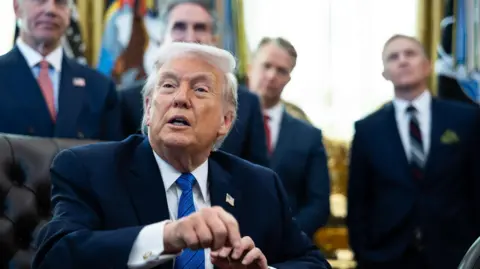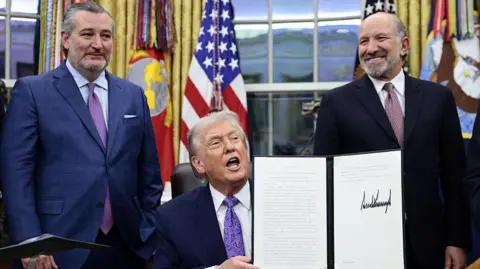
US President Donald Trump has signed an executive order aimed at blocking states from enforcing their own artificial intelligence (AI) regulations.
We want to have one central source of approval, Trump told reporters in the Oval Office on Thursday.
This order grants the Trump administration tools to counter the most onerous state rules, with White House AI adviser David Sacks noting that the government would not oppose AI regulations concerning children's safety.
The initiative has been heralded as a victory for technology giants who have advocated for a cohesive national policy on AI, anticipating it will significantly impact the U.S.'s objective of leading in this rapidly advancing field.
AI executives have expressed concerns that state-level regulations may impede innovation and diminish the nation’s competitiveness against China, as companies invest billions into AI development.
However, the announcement has faced strong opposition. California, host to many prominent tech enterprises, already has its AI regulations in place. Governor Gavin Newsom criticized the executive action, accusing Trump of corruption and asserting that the order seeks to enrich his associates while undermining measures designed to safeguard Americans from unregulated AI.
Earlier this year, Newsom enacted legislation mandating that large AI firms devise plans to mitigate risks associated with their technologies. States like Colorado and New York have also established regulations for AI development.
Newsom argues that his state's law should serve as a model for federal lawmakers. Opponents of Trump's order maintain that permitting states to set their own AI regulations is essential, especially given the vacuum of effective federal oversight.
Stripping states from enacting their own AI safeguards undermines states' basic rights to establish sufficient guardrails to protect their residents, remarked Julie Scelfo from the advocacy group Mothers Against Media Addiction.