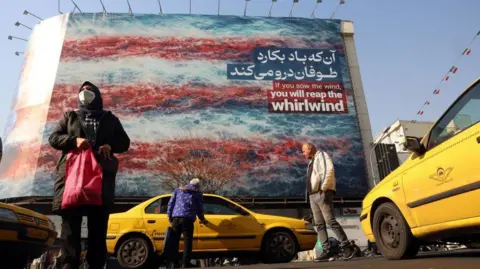
Amid the din of global speculation over a U.S. military build-up in the Middle East, Israeli leaders have remained unusually silent. Except for some remarks supporting Iran's anti-government protests this month, Israel's prime minister has offered little public commentary regarding his superpower ally's confrontation with his country's biggest enemy. This reticence suggests a deliberate strategy, as Danny Citrinowicz, a senior Iran researcher at Israel's Institute for National Security Studies, explains. He emphasized the significance for Prime Minister Netanyahu, who sees the moment as a ‘golden opportunity’ for potential regime change in Tehran with strong U.S. backing.
The Israeli leadership appears to believe it prudent to let the U.S. take the lead in military action due to its superior capabilities and global legitimacy. But behind closed doors, discussions about interrogating possible targets in Iran are heating up, indicative of the seriousness with which Israel regards the situation. With discussions about military action intensifying, it's critical to consider the potential consequences of a regime change in Iran.
Support for precision strikes and regime change is echoed by many in Israel, who view Iran as a primary threat. A successful regime change could diminish Iran's military capacities, especially regarding ballistic missiles and nuclear potential, as well as weaken proxy forces like Hezbollah.
However, the risks associated with this strategy cannot be overlooked. The regional instability that could follow a regime change in Iran raises significant concerns among analysts, as does the potential for a civil war and what that could mean for local populations.
Both Israel and the U.S. are facing a complex decision regarding their approach. Recent polls indicate a majority of Israelis favor a militarized response against Iran, but the lack of a clear successor in Iran and fears of retaliation could complicate any military strategy. Thus, as tensions rise, the silence from Israel may well be part of a broader tactical posture, weighing the possibilities against the unpredictable nature of geopolitical conflict.
The Israeli leadership appears to believe it prudent to let the U.S. take the lead in military action due to its superior capabilities and global legitimacy. But behind closed doors, discussions about interrogating possible targets in Iran are heating up, indicative of the seriousness with which Israel regards the situation. With discussions about military action intensifying, it's critical to consider the potential consequences of a regime change in Iran.
Support for precision strikes and regime change is echoed by many in Israel, who view Iran as a primary threat. A successful regime change could diminish Iran's military capacities, especially regarding ballistic missiles and nuclear potential, as well as weaken proxy forces like Hezbollah.
However, the risks associated with this strategy cannot be overlooked. The regional instability that could follow a regime change in Iran raises significant concerns among analysts, as does the potential for a civil war and what that could mean for local populations.
Both Israel and the U.S. are facing a complex decision regarding their approach. Recent polls indicate a majority of Israelis favor a militarized response against Iran, but the lack of a clear successor in Iran and fears of retaliation could complicate any military strategy. Thus, as tensions rise, the silence from Israel may well be part of a broader tactical posture, weighing the possibilities against the unpredictable nature of geopolitical conflict.