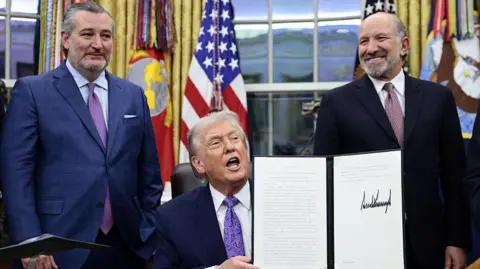
US President Donald Trump has signed an executive order aimed at blocking states from enforcing their own artificial intelligence (AI) regulations.
We want to have one central source of approval, Trump told reporters in the Oval Office on Thursday.
This order gives the Trump administration tools to push back on what White House AI adviser David Sacks described as the most onerous state rules, while clarifying that the government will not oppose regulations focused on children's safety.
The executive order has been seen as a significant win for technology companies that have been advocating for uniform federal legislation to facilitate the growth of the AI industry in the US.
AI company executives argue that inconsistent state-level regulations might stifle innovation and hinder America's competitive edge against global leaders like China in this rapidly evolving sector.
However, the announcement has faced considerable opposition. California, home to numerous tech giants, has its stringent AI regulations, which Governor Gavin Newsom criticized as an attempt by Trump to enable unregulated AI technologies.
Governor Newsom accused Trump of prioritizing personal interests over public safety, pointing to a recently signed bill in California that requires major AI firms to develop risk mitigation plans concerning their technologies.
Meanwhile, states such as Colorado and New York have also enacted their own AI regulations, demonstrating a growing trend among states to approach this issue distinctly.
Critics assert that Trump's executive order undermines the right of states to create necessary safeguards in the absence of federal regulations. Julie Scelfo, from advocacy group Mothers Against Media Addiction, expressed concern over the potential danger posed by eliminating state-level laws.
Conversely, some experts argue that a unified federal law could prevent the disarray that arises from a patchwork of opposing state rules, although the quality of the proposed federal law is paramount.
The tech lobby group NetChoice applauded the executive order and expressed eagerness to collaborate with the White House and Congress to establish comprehensive national standards for AI.