Hong Kong pro-democracy campaigner and media tycoon Jimmy Lai has been found guilty of colluding with foreign forces under the the city's controversial national security law (NSL).
The 78-year-old, who has been in jail since December 2020, pleaded not guilty. He faces life in prison and is expected to be sentenced early next year.
Lai used his now-defunct Apple Daily newspaper as part of a broader effort to lobby foreign governments to impose sanctions on Hong Kong and China, the court found.
Hong Kong's chief executive, John Lee, welcomed the verdict, noting that Lai's actions 'damaged the country's interests and the welfare of Hong Kongers,' but rights groups have called it 'a cruel judicial farce.'
They assert that the NSL, which Beijing defends as essential for the city's stability, has been utilized to suppress dissent.
Judge Esther Toh stated that there is 'no doubt' Lai 'harboured hatred' for the People's Republic of China, citing his 'constant invitation to the US to help bring down the government of the PRC under the pretext of aiding the people of Hong Kong.'
Lai testified that he had 'never' used his foreign contacts to influence foreign policy regarding Hong Kong. He explained that he merely relayed information about the situation in Hong Kong when talking to US officials.
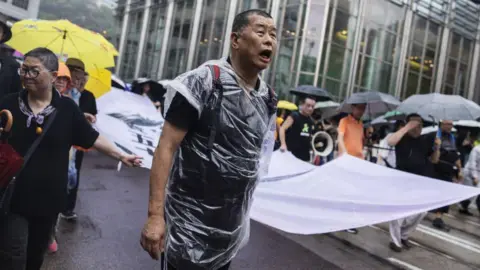
A significant figure during the pro-democracy protests in 2019, Lai has faced a long and arduous legal battle. The NSL was enacted without legislative consultation, allowing authorities broad powers to charge individuals labeled threats to public order and national stability.
In addition to collusion charges, Lai has also been convicted of publishing seditious material through Apple Daily under colonial-era laws.
When the verdict was delivered, Lai remained calm, bidding farewell to his family members present in court, which included his wife and son, as well as Cardinal Joseph Zen, a close friend.
Following the verdict, Lai's lawyer stated that his client’s spirit was 'okay' and they would need time to review the lengthy judgment before deciding on an appeal.
Elaine Pearson from Human Rights Watch accused the Chinese government of using Lai to intimidate dissenters and urged governments worldwide to pressure authorities for his immediate release.
Throughout this ordeal, Lai remains a symbol of the pro-democracy movement, with supporters expressing solidarity at his trial.
His case is seen as pivotal in evaluating the judicial independence of Hong Kong's courts, which have faced scrutiny amid increasing government control.
Despite assurances of upholding rule of law, critics point to a high conviction rate under the NSL, indicating serious challenges for those who oppose the government.