In brief
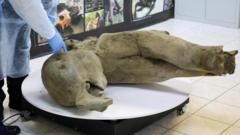
Russian scientists announce the discovery of “Yana,” a remarkably preserved baby mammoth, estimated to be 50,000 years old, found in the Batagaika crater of Yakutia. As climate change accelerates permafrost thawing, more prehistoric remains are being unearthed, prompting important research into ancient ecosystems.
In a remarkable find underscoring the effects of climate change on our planet's history, Russian scientists have revealed the remains of a 50,000-year-old baby mammoth dubbed “Yana,” discovered in the thawing permafrost of Yakutia, Siberia. The discovery occurred during the summer when local residents stumbled upon the ancient carcass in the world's largest permafrost crater, known as the Batagaika crater. Yana, who weighed over 100 kg and stood at 120 cm tall, is believed to have been just one year old at the time of her death. Researchers confidently assert that Yana is the best-preserved mammoth ever found, with remarkably intact features despite some forelimbs having been eaten by local wildlife. Maxim Cherpasov, the head of the Lazarev Mammoth Museum Laboratory, explained that the residents who discovered Yana crafted a makeshift stretcher to rescue the remains from the thawed ground, capturing an extraordinary moment in the region's paleontological history. Gavril Novgorodov, another researcher, speculates that Yana became trapped in a swamp, which contributed to her exceptional preservation for millennia. Currently housed at the North-Eastern Federal University in Yakutsk, scientists are conducting tests to determine the exact timing of Yana’s demise. This discovery comes alongside numerous other prehistoric finds in Siberia, revealing that as the climate warms and permafrost thaws, remnants of ancient civilizations and wildlife continue to emerge. Earlier in the year, remains of a 44,000-year-old wolf and the body of a nearly 32,000-year-old sabre-tooth cat were also uncovered in the same region. These finds are fostering an intense research interest aimed at understanding the flora and fauna of ancient ecosystems and their potential implications for present-day biodiversity in the face of climate change. As thawing permafrost continues, it raises questions about what other secrets from our planet's distant past may soon come to light.