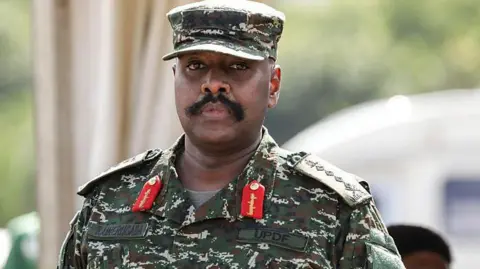
A fiery tweeter who is in charge of Uganda's military, Gen Muhoozi Kainerugaba is decried by his critics as being in the middle of an unholy trinity, or alliance, of three men who rule the East African nation with an iron fist. Kainerugaba, the son of the country's long-time leader Yoweri Museveni, has posted on social platform X about the killing of opposition supporters during this month's fiercely contested presidential election.
In posts which were subsequently deleted, he also threatened to have the testicles of defeated opposition candidate Bobi Wine removed. With the 81-year-old president winning a seventh term, analysts say this is likely to be his last term and he is grooming his 51-year-old son to succeed him. The so-called unholy alliance - a play on the Christian doctrine of the Holy Trinity - is made up of Museveni, Kainerugaba, and the president's powerful brother and special adviser, Salim Saleh.
Kenya-based analyst for the Institute for Security Studies think-tank, Nicodemus Minde, notes that the Father is Museveni, the Son is Kainerugaba, and the Unholy Spirit could be the uncle, Salim Saleh. This provocative language plays into the perception that the ruling family considers their grip on power as divinely sanctioned.
During the election, many opposition supporters accused the Museveni family of believing in a god-given right to rule Uganda. After Museveni's victory with more than 70% of the vote, Wine dismissed the results as fake, claiming widespread ballot-stuffing was responsible for Museveni's win. Kainerugaba responded by threatening Wine with arrest if he did not present himself to police within 48 hours.
This pattern of aggression is distressing to many observers as Kainerugaba has a history of controversial public statements. He famously claimed that my bloodline is from Jesus Christ yet later apologized for some of his remarks after backlash. Kainerugaba's recent comments could escalate tension within Uganda and potentially strain relations with countries like the United States from which he accused of meddling in Ugandan politics.
As the political landscape evolves, Kainerugaba's actions suggest a strategic maneuvering for power. His provocative tweets, once discounted as erratic behavior, are increasingly seen as calculated steps in a complex political and familial legacy, raising alarms about the future direction of Uganda under potential leadership of the next generation.
In posts which were subsequently deleted, he also threatened to have the testicles of defeated opposition candidate Bobi Wine removed. With the 81-year-old president winning a seventh term, analysts say this is likely to be his last term and he is grooming his 51-year-old son to succeed him. The so-called unholy alliance - a play on the Christian doctrine of the Holy Trinity - is made up of Museveni, Kainerugaba, and the president's powerful brother and special adviser, Salim Saleh.
Kenya-based analyst for the Institute for Security Studies think-tank, Nicodemus Minde, notes that the Father is Museveni, the Son is Kainerugaba, and the Unholy Spirit could be the uncle, Salim Saleh. This provocative language plays into the perception that the ruling family considers their grip on power as divinely sanctioned.
During the election, many opposition supporters accused the Museveni family of believing in a god-given right to rule Uganda. After Museveni's victory with more than 70% of the vote, Wine dismissed the results as fake, claiming widespread ballot-stuffing was responsible for Museveni's win. Kainerugaba responded by threatening Wine with arrest if he did not present himself to police within 48 hours.
This pattern of aggression is distressing to many observers as Kainerugaba has a history of controversial public statements. He famously claimed that my bloodline is from Jesus Christ yet later apologized for some of his remarks after backlash. Kainerugaba's recent comments could escalate tension within Uganda and potentially strain relations with countries like the United States from which he accused of meddling in Ugandan politics.
As the political landscape evolves, Kainerugaba's actions suggest a strategic maneuvering for power. His provocative tweets, once discounted as erratic behavior, are increasingly seen as calculated steps in a complex political and familial legacy, raising alarms about the future direction of Uganda under potential leadership of the next generation.