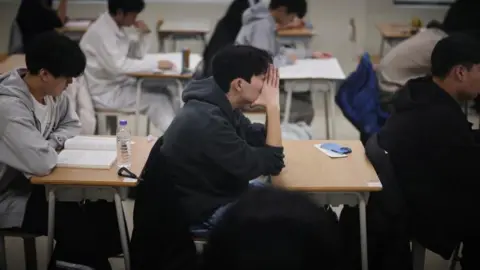
The English section of South Korea's gruelling college entrance exam, or Suneung, is notoriously difficult, with some students comparing it to deciphering an ancient script, while others call it 'insane.'
So intense was the criticism surrounding this year's test that Oh Seung-geol, the top official in charge of administering it, resigned to take responsibility for the chaos it caused.
'We sincerely accept the criticism that the difficulty of questions... was inappropriate,' said Suneung chief Oh Seung-geol, adding that the test fell short despite having gone through several rounds of editing.
Among the most daunting questions are one on Immanuel Kant's philosophy of law and another involving gaming jargon. The gaming question asks students to select the correct placement of a complex sentence within a paragraph.
Critics on Reddit labeled the question as 'fancy smart talking' and 'awful writing,' calling into question the clarity and comprehension of the material. This year, only 3% of test-takers achieved the highest grade in the English section, a drop from 6% the previous year.
Im Na-hye, a senior from Hanyeong High School, stated, 'It took me a long time to figure out several questions, and understanding the texts themselves was tricky,' reflecting the stress students face during this eight-hour examination marathon.
English language professor Jung Chae-kwan criticized the exam's format, stating, 'You don't even really need to read the full text to get the points if you know the tricks.' He emphasized that the focus should be on meaningful education rather than exam techniques.
Contrarily, some educators defended the test's rigor, explaining that it accurately measures students’ reading comprehension skills necessary for university-level literature.
The Suneung, which occurs annually every November, dictates the academic future of many South Korean students. It remains a monumental event, halting construction work and even military training across the country to ensure a conducive testing environment. Notably, only four of the twelve Suneung chiefs since its inception in 1993 have completed their full terms, highlighting the pressures associated with this high-stakes exam.
Additional reporting by Hyojung Kim and Jake Kwon in Seoul.