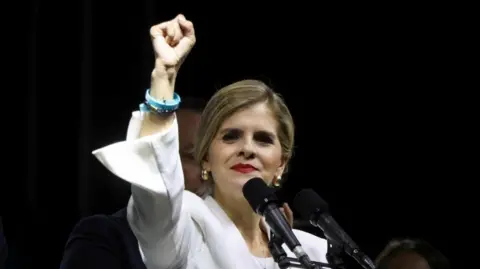
The candidate for the governing conservative Sovereign People's Party, Laura Fernández, has won the presidential election in Costa Rica.
With more than 88% of the votes counted, Fernández had over 48% of the votes, far ahead of the second-placed centrist candidate, Álvaro Ramos, who conceded defeat.
Fernández ran on a promise to deepen the tough-on-crime approach of the outgoing President Rodrigo Chaves, who had handpicked her as his successor.
Voters had expressed concerns about a surge in drug-related violence in the Central American country. Fernández's significant vote share exceeds the 40% needed to win outright in the first round, eliminating the need for a run-off.
She will be sworn in on May 8 and has vowed to continue the policies introduced by Chaves, whose chief of staff she was.
Under Costa Rica's constitution, presidents cannot serve two consecutive terms, thus Chaves was barred from re-election. Fernández hinted at appointing him to a post in her cabinet.
Despite being one of Central America's safest countries, Costa Rica has witnessed a rise in crime due to the expansion of transnational criminal gangs in the region. On the campaign trail, Fernández stated she would emulate some of El Salvador's President Nayib Bukele's approaches, who has earned high approval ratings for his strict crime policies.
Fernández plans to declare a state of emergency in areas dominated by gangs and finish the construction of a high-security prison similar to the Cecot in El Salvador.
While addressing concerns from critics that her policies could infringe on citizen rights, she emphasized her commitment to a government of “dialogue and national harmony” based firmly on the rule of law. She criticized the opposition for its obstructive tactics against Chaves’s policies.
With her party winning 30 out of 57 seats in parliament, Fernández is anticipated to have greater legislative support than her predecessor.
Before her presidency, the 39-year-old served as planning minister and is known for her direct style, which mirrors that of Chaves. She is expected to maintain the close relationship with the US established during her predecessor's administration.
Fernández has shown a willingness to declare a state of emergency and limit certain rights should organized crime further endanger specific areas.
She will be the second woman to govern Costa Rica, following Laura Chinchilla's presidency in 2010.