With a pit in their stomach, families and industries across Europe are watching gas prices and the cost of filling vehicles with petrol spiral.
While the UK government has told voters pretty much to keep calm and carry on, the European Commission - the EU's executive arm - has called on people to work more from home and to travel a lot less. Policymakers warn things could get much worse - depending on what happens next in the Middle East. Yet it feels like only yesterday that Europeans faced a cost-of-living crisis on the back of spiraling energy costs and inflation following Russia's full-scale invasion of Ukraine.
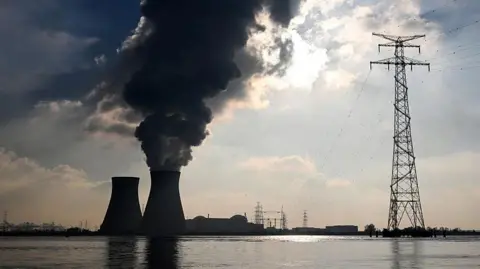
This means conversations in Europe are turning (again) to the issue of energy independence. And nuclear energy seems to be back in fashion as part of a home-grown European energy mix - in the UK as well as the EU. But how quick a fix can nuclear be - and how safe and reliable is it really?
At the recent European Nuclear Energy Summit in Paris, European Commission chief Ursula von der Leyen described Europe broadly turning its back on nuclear as a strategic mistake. In 1990, Europe produced around a third of its electricity from nuclear power. That has now fallen to an average of 15%, leaving the continent completely dependent on expensive and volatile imports of fossil fuels, she said, putting Europe at a disadvantage compared with other regions.
This leaves the continent vulnerable to unexpected reductions in supply. Europe imports more than 50% of its energy, mainly oil and gas. Gas prices rise at a similar rate across Europe but the impact on electricity prices varies depending on each country's energy mix.
In Spain, which has invested heavily in wind and solar power, the average electricity price is forecasted to be around half of Italy’s, where gas determines the electricity price 90% of the time. France, Europe's largest nuclear producer, generates about 65% of its electricity from nuclear power. Recent economic forecasts for Germany reflect its reliance on gas, creating significant pressure on its economic growth.
Speculations about renewed enthusiasm for nuclear power in Europe include Italy preparing to repeal its ban, Belgium reversing its stance on investing in nuclear energy, Greece opening discussions on advanced reactor designs, and Sweden undoing its long-standing decision to abandon nuclear. In the UK, regulatory streamlining aims to facilitate nuclear project development.
President Emmanuel Macron emphasized nuclear power’s low carbon-emission credentials, arguing that it is key to achieving both energy sovereignty and carbon neutrality. However, environmental advocates warn that investing in nuclear may divert resources away from renewable energy development and highlight the risk of dependency on Russian nuclear technology in Central European countries.
The discussion around nuclear power as part of Europe's medium to long-term solution is heating up, yet immediate concerns about energy independence remain paramount. Investment in small modular reactors (SMRs) is seen as a potential game-changer, but the technology's commercial viability is still unproven. Moreover, nuclear is challenged by its cost compared to rapidly decreasing prices in solar and wind technology.
As Europe navigates its energy future, nuclear could play a significant role, but its path is fraught with obstacles. The importance of moving away from fossil fuel dependence while maintaining a balanced and sustainable energy strategy cannot be overstated.