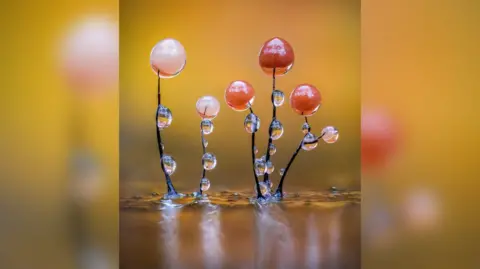
Welcome to the world of slime mould.
These images, captured by photographer Barry Webb, provide a close-up view of single-celled slime mould organisms—a view that would not be possible with the naked eye.
Using a high-powered macro lens and a composite of stills, Barry reveals the tiny structures of these organisms, which can grow anywhere from forests to deserts.
Barry, who has earned accolades for his work, recently won the people's choice award in the macro section of the British Photography Awards.
Barry says he didn't know they existed before being introduced to the world of slime mould in 2019. A gardener by trade and a passionate hobby photographer, the Covid lockdown allowed him more opportunities to explore these fascinating organisms.
It's not fungi, it's not a plant, it's not animal. It's more closely related to an amoeba, Barry explains, emphasizing the unique biology of slime mould. He focuses on photographing the fruiting bodies of slime mould, where intense color and drama occur, releasing spores while feeding off bacteria, algae, and fungi, making them an essential part of the ecosystem.
Moreover, findings by the RHS highlight the practical applications of slime mould, including urban transport mapping simulations and its role in the search for dark matter.
Barry explains that photographing slime mould is intricate, utilizing a technique known as focus bracketing to create his stunning macro images. The process involves taking numerous photos—sometimes over 100—to achieve a final picture that encapsulates the marvel of these organisms.
Each of Webb’s photos reveals a world unseen by the naked eye, drawing attention to the beauty and ecological importance of slime mould.