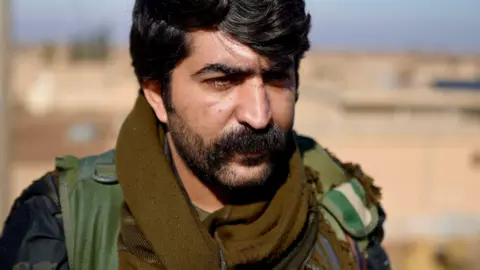
As a veteran Syrian Kurdish fighter, Commander Azad – whose nom-de-guerre means freedom - walks with a limp and wears his battle scars with pride. 'My leg was injured when we were bombed by a Turkish warplane in 2018,' he says. 'And this was shrapnel from a suicide bomber,' he adds, rolling up his sleeve to reveal a deep gouge in his arm. 'My back, abdomen, and lower body were all injured in four separate attacks by Daesh,' he states, using the Arabic acronym for the Islamic State group (IS).
His latest wound is below the surface, driven by what he perceives as betrayal by a previous ally, the United States. After IS seized significant territories in Syria and Iraq in 2014, the U.S. and the Kurds collaborated to push them back. 'Not anymore,' Azad laments, asserting, 'History will hold them accountable... But we will keep fighting until our last breath. We are not cry-babies.'
Currently, their conflict pits them against the central government in Damascus, which aims to reassert control over the Kurdish autonomous region in the northeast. In recent weeks, government troops have successfully pushed the Kurdish-led Syrian Democratic Forces (SDF) out of resource-rich areas they had managed for a decade since defeating IS.
The White House's support for Syria's interim president, Ahmed al-Sharaa – a former jihadist – has further strained relations. Azad draws parallels between the new president and IS's founder, stating, 'They are the same thing. After Jolani took over, Syria will always be a war zone.'
Despite the challenges, Kurdish forces remain steadfast. Ali, another fighter, mourns the loss of many friends in the conflict against IS. 'I walk in their footsteps,' he says, recalling the deep personal connections to his fallen comrades. Meanwhile, Hekmiya Ibrahim, who manages a detention camp for IS affiliates' families, worries about the radicalization among detainees and the potential implications for global security.
As tensions grow, efforts for a permanent ceasefire continue amidst fears of escalating conflict. Ali emphasizes, 'We don't want war, but if we are forced down that path, we will fight back. Every neighborhood will turn into hell for them.'
The situation remains precarious as the area is home to thousands of suspected IS fighters and their families, raising concerns about future violence and regional stability. The fight for Kurdish autonomy in Syria becomes a focal point not only for local implications but worldwide as security dynamics evolve.
His latest wound is below the surface, driven by what he perceives as betrayal by a previous ally, the United States. After IS seized significant territories in Syria and Iraq in 2014, the U.S. and the Kurds collaborated to push them back. 'Not anymore,' Azad laments, asserting, 'History will hold them accountable... But we will keep fighting until our last breath. We are not cry-babies.'
Currently, their conflict pits them against the central government in Damascus, which aims to reassert control over the Kurdish autonomous region in the northeast. In recent weeks, government troops have successfully pushed the Kurdish-led Syrian Democratic Forces (SDF) out of resource-rich areas they had managed for a decade since defeating IS.
The White House's support for Syria's interim president, Ahmed al-Sharaa – a former jihadist – has further strained relations. Azad draws parallels between the new president and IS's founder, stating, 'They are the same thing. After Jolani took over, Syria will always be a war zone.'
Despite the challenges, Kurdish forces remain steadfast. Ali, another fighter, mourns the loss of many friends in the conflict against IS. 'I walk in their footsteps,' he says, recalling the deep personal connections to his fallen comrades. Meanwhile, Hekmiya Ibrahim, who manages a detention camp for IS affiliates' families, worries about the radicalization among detainees and the potential implications for global security.
As tensions grow, efforts for a permanent ceasefire continue amidst fears of escalating conflict. Ali emphasizes, 'We don't want war, but if we are forced down that path, we will fight back. Every neighborhood will turn into hell for them.'
The situation remains precarious as the area is home to thousands of suspected IS fighters and their families, raising concerns about future violence and regional stability. The fight for Kurdish autonomy in Syria becomes a focal point not only for local implications but worldwide as security dynamics evolve.