A South African court has dismissed an appeal by the country's heritage body to stop the sale and export of various artefacts connected to anti-apartheid hero Nelson Mandela.
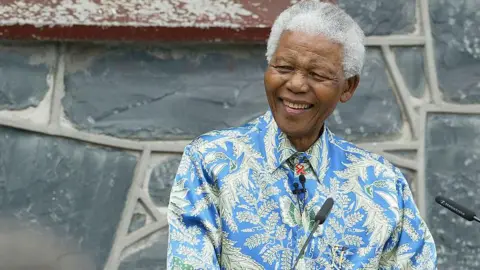
The 70 personal items include a cell key from Robben Island, where Mandela was imprisoned for 18 of the 27 years he was locked up, a pair of Aviator sunglasses and one of his signature floral shirts. They were due to be exported to the US for auction.
The objects belong to his eldest daughter, Makaziwe Mandela and Christo Brand, a Robben Island warden during Mandela's incarceration. In trying to stop their sale, the authorities argued that the items were part of the country's heritage and therefore legally protected from export.
The South African Heritage Resources Agency (SAHRA) learned about the potential sale through a British media report in late 2021, claiming that the key could fetch more than £1m ($1.35m).
SAHRA then contacted the US auction house, Guernsey, planning the sale to request the auction be suspended and the assets returned to South Africa.
Other items included in the auction are a signed copy of the 1996 South African Constitution, a charcoal drawing by Mandela, his ID card, a tennis racquet used on Robben Island, and gifts from world leaders, including one from former US President Barack Obama and his wife Michelle.
Mandela's daughter wants to use the auction proceeds to create a memorial garden at the late former president's grave in Qunu, located in the Eastern Cape province.
In its ruling, the Supreme Court of Appeal noted that SAHRA's interpretation of which items fell under the National Heritage Resources Act was overly broad, and that Makaziwe and Brand had provided detailed explanations for why the assets should not be considered heritage objects, while SAHRA failed to offer justifiable grounds for claiming they were.
It remains uncertain if authorities will pursue other legal options to block the sale. Some supporters of the government's stance believe that items connected to Mandela should remain in South Africa, preserved for future generations, while others argue that his family should have the authority over the objects' fate.
Mandela passed away in 2013 at the age of 95, having led the African National Congress in its fight against apartheid. He was released from prison in 1990 and awarded the Nobel Peace Prize in 1993, sharing it with then-President FW de Klerk. In 1994, Mandela became South Africa's first democratically elected president.